

Imagine your newborn is very sick.
Doctors are doing tests, but nobody knows exactly what is wrong.
Normally, finding the answer to a rare genetic condition can take weeks — sometimes much longer.
But doctors in Dubai are testing a new approach that could make that wait much shorter.
It’s called Little Falcon. 💜
What is Little Falcon?
Little Falcon is a Dubai program that uses rapid whole-genome sequencing for critically ill babies and children.
That sounds complicated, but the idea is actually simple.
Think of DNA as your baby’s enormous instruction book.
Sometimes, a tiny change somewhere inside that book can cause a serious health problem.
Instead of testing one small part at a time, doctors can now look through almost the entire genetic “book” at once.
From 38 days… to around 3 days
This is the part that caught our attention.
Researchers studied 100 critically ill babies and children.
With traditional genetic testing, results previously took around:
38 days
With Little Falcon, the average waiting time was only about:
3.4 days
For parents waiting beside a sick baby in intensive care, those extra weeks can feel like forever.
Doctors found an answer for more than half
The rapid DNA testing found a genetic diagnosis in:
53% of the children
And it wasn't simply giving the condition a name.
For 53% of patients, the genetic result also led doctors to make a meaningful change in their medical care.
That might mean changing treatment, avoiding unnecessary tests, or giving the medical team a clearer idea of what to do next.
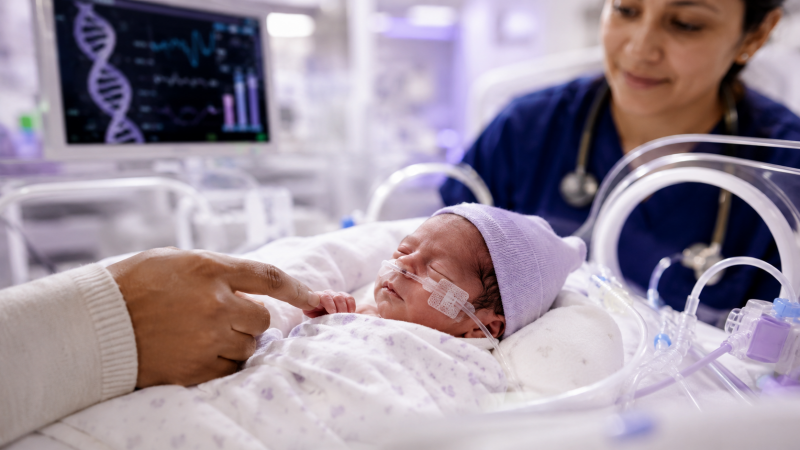
Why is this especially interesting for newborns?
When a newborn becomes seriously ill, doctors often have to make decisions very quickly.
But babies can't tell us what hurts or how they feel.
And some rare genetic conditions can look very similar at first.
Being able to examine the baby's DNA within a few days may give doctors another important clue.
It doesn't replace doctors, examinations or normal medical tests.
It's simply another powerful tool they may be able to use.
Does every baby need their DNA sequenced?
No.
This is important.
The Little Falcon project involved critically ill babies and children in intensive care when doctors suspected a genetic condition.
It does not mean that every healthy newborn needs whole-genome sequencing.
Genetic testing can also raise complicated questions, which is why genetic specialists and counselors are involved when these tests are used.
Why we love this story
At Malik’s World, we normally talk about things like baby essentials, nurseries and parenting.
But stories like this remind us just how quickly the world of newborn care is changing.
A few years ago, reading almost an entire human genome quickly enough to influence intensive-care decisions would have seemed extraordinary.
Now, doctors in Dubai are doing exactly that.
And for some families, receiving an answer in days instead of weeks could make an enormous difference.
A little falcon with a big future
We also love the name.
Little Falcon feels perfect for a project born in the UAE — small, fast and powerful.
The study is still relatively small, with 100 patients, and more research will be needed.
But it offers a fascinating glimpse into what newborn and pediatric medicine may look like in the future.
Sometimes the next big step in caring for a tiny baby may begin by understanding something even smaller:
their DNA. 💜
Malik’s World — Little finds, big smiles.
Parent note: This article is for general information only and is not medical advice. If you have concerns about your baby’s health or genetic testing, speak with your pediatrician or a qualified genetic specialist.
Source: Research published in Nature Medicine on August 24, 2026, on Dubai’s Little Falcon rapid whole-genome sequencing program.