

Sometimes one of the most powerful things a parent can give a newborn isn't something that comes in a box.
It's simply being close.
This is the real story of Falastiin Abdullahi, a mother of three in Somalia whose newest baby arrived earlier than expected.
Her story was documented by UNICEF in May 2026.
A Birth That Came Too Soon
Falastiin had experienced a difficult pregnancy.
Then her baby arrived prematurely.
Instead of the peaceful first days she may have imagined, her tiny newborn needed urgent care in the Neonatal and Baby Care Unit at Banadir Hospital in Mogadishu.
Falastiin stayed close to him.
She later told UNICEF:
“I was very worried when my baby was born early.”
For any parent, seeing a newborn needing specialized care can be frightening.
For Falastiin, those early days were filled with uncertainty.
Her baby was small, fragile, and needed help.
But alongside the medical care he received, something remarkably simple became part of his treatment:
his mother's embrace.
Holding Him Close
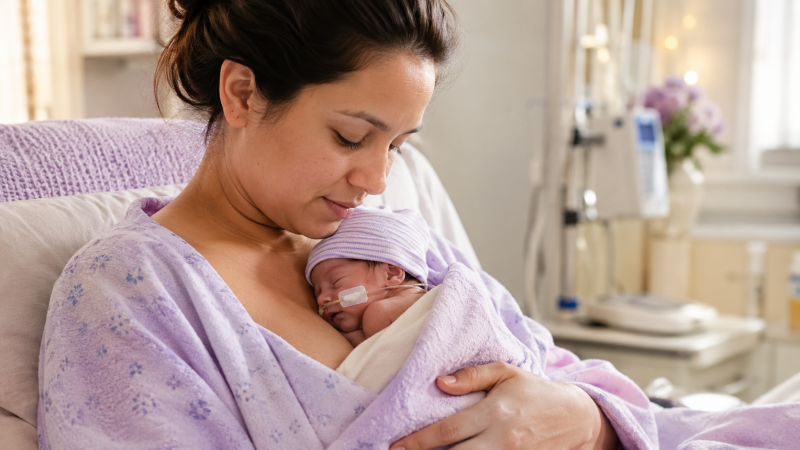
At the hospital, Falastiin practised Kangaroo Mother Care, often called KMC.
Her newborn was placed directly against her chest and secured close to her body.
There were no complicated machines involved in this part of his care.
Just a tiny baby resting against his mother, surrounded by her warmth and the familiar sound of her heartbeat.
UNICEF photographed Falastiin holding him this way as he slept peacefully against her chest.
It may look like a beautiful bonding moment.
But for premature and low-birth-weight babies, skin-to-skin care can be much more than that.
Why This Simple Embrace Matters
The World Health Organization recommends Kangaroo Mother Care for premature and low-birth-weight newborns.
KMC combines prolonged skin-to-skin contact with support for breast-milk feeding and close follow-up.
WHO says it should begin as soon as possible after birth for these babies and, where possible, continue for many hours each day.
Research behind WHO's recommendations has found that Kangaroo Mother Care can help reduce:
- Hypothermia
- Infections
- Mortality among premature and low-birth-weight babies
It can also support feeding and healthy weight gain.
For babies who have difficulty regulating their body temperature because they were born too early or too small, the parent's body can provide something remarkably powerful:
warmth.
More Than Medical Care
There is another side to Falastiin's story that numbers can't completely describe.
Being able to participate in her baby's care gave her something to do during a frightening time.
Instead of only standing beside an incubator and watching, she could hold him.
Comfort him.
Keep him warm.
Be part of his care.
WHO's newer guidance emphasizes keeping parents and premature newborns together whenever their medical condition allows it, rather than unnecessarily separating them.
For a parent facing the uncertainty of premature birth, that closeness can matter emotionally too.
A Reminder for Every Parent
Most babies will never need the same care Falastiin's newborn needed.
But her story carries a beautiful reminder that applies far beyond the neonatal unit.
When preparing for a baby, we're surrounded by lists.
The best crib.
The perfect stroller.
The right bottles.
The newest monitor.
The softest clothes.
And many of those things can certainly make family life easier.
But babies also need something that can't be ordered online:
closeness, comfort, warmth and the presence of the people who love them.
Sometimes the smallest moments are among the most important.
A tiny hand wrapped around your finger.
A newborn sleeping against your chest.
The sound of breathing while you hold them close.
These are ordinary moments.
And yet, as Falastiin's story shows, sometimes an ordinary embrace can become something extraordinary.
What Parents Should Know
Kangaroo Mother Care is specifically recommended for premature and low-birth-weight newborns and should be provided with appropriate healthcare guidance.
If your baby is born prematurely, has a low birth weight, or requires neonatal care, speak with the baby's medical team about when and how skin-to-skin contact can be safely provided.
Every baby's medical situation is different.
For parents of healthy full-term newborns, skin-to-skin contact shortly after birth is also widely encouraged when mother and baby are medically stable. WHO includes immediate skin-to-skin contact as part of essential newborn care.
Little Moments Can Mean Everything
Falastiin entered the hospital frightened for her premature baby.
Then, day after day, she held him close.
Her story isn't really about a product.
It's about something much simpler.
A mother.
A newborn.
And the quiet power of being together.
At Malik's World, that's something we want to remember as we talk about baby essentials, products and parenting:
Sometimes the most important things aren't things at all. 💜
Malik's World — Little finds, big smiles.
Original story: UNICEF — Falastiin and her premature baby
Medical guidance: WHO — Kangaroo Mother Care